
PAGE IN PROGRESS
Contents
Introduction
John Nyren’s The Cricketers of my Time is generally considered the most important of all cricket writings about the early game, and included within it is a text added on when the writings transferred from a publication in a periodical (1832) to book form (1833) . This text was entitled A few Memoranda respecting the Progress of Cricket and contains several nuggets of information not available elsewhere. It can be found here.
The memoranda is introduced by the following sentence:
Mr. Ward obligingly furnished me with a small MS., written some years since by an old cricketer, containing a few hasty recollections and rough hints to players, thrown together without regard to method or order. From the mass I have been able to select a few portions, thinking that they might possess some interest with those of my readers who take a pride in the game.
We know who Mr Ward is – he is William Ward (1787 – 1849), an English financier and MCC cricketer. His score of 278 for the MCC v Norfolk at Lord’s in 1820 was the highest individual innings in important matches until W. G. Grace scored the first triple-century in August 1876. In 1825, when the future of Lord’s was in doubt due to proposals for housing development, Ward stepped in and purchased the leasehold for £5,000, which he kept for 10 years before selling it on to James Dark.
We are not told, however, who the old cricketer (‘OC’) is or how the document came to be in Ward’s hands. I must admit, I had taken it, without much thought, that ‘written some years since’ meant written a very long ago indeed and that the opening reference to cricket 150 years ago (i.e., around 1680) was a personal recollection of the OC. This would mean that he was perhaps born around 1760 and lived to 1740. The document might then have been written in 1730 and passed to Ward by a descendant. So when the text uses the phrase at the start of the second paragraph, ‘From the authority before me’ he is referring to the OC’s document. This continues, according to my assumption, and, I think, of most readers, only until the 1746 scorecard when Nyren returns to his own recollections.
Clarke’s Theory
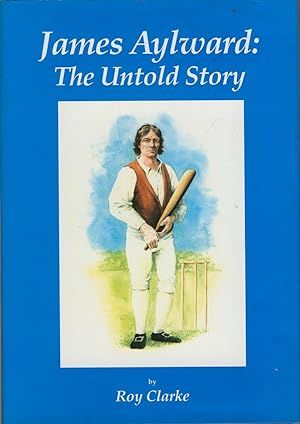
This comfortable assumption was disturbed by reading Roy Clarke’s short book, James Alyward: The Untold Story, published in 2001 in a limited edition of 500. In it he argues that:
(1) Aylward was the OC and
(2) that he was the author of much of the memoranda, subject to occassional interpolations by Nyren, and that
(3) Aylward’s great innings was a response to, almost a protest against, the introduction of the third stump.
Consideration of Clarke’s ideas
Evidence that the memorandum is substantially all the work of OC
Clarke raises many points, and these are summarised below:
- Many readers have found the memoranda puzzling. For example, Ashley Mote says, ‘The problem John Nyren had with the form and contents of his memoranda is still a puzzle to the reader today.
- Nyren says in Cricketers of My Time he has no data available, but data, including scorecards, appear in the memoranda.
- In Cricketers of My Time, Nyren states that as far as he can recall, the third stump change occurred in 1779 or 1780, but the memoranda pins it down to 1777.
- In Cricketers of My Time, especially the dedication, Nyren rails against the practice of roundarm bowling, which he calls throwing. The author of the memoranda, however, takes a more relaxed view, suggesting the problem has gone away. More on this below.
- In the section of the memoranda, the author claims to have been consulted on the third stump issue, but Nyren would only have been eleven in 1777 when the third stump was in use. In light of this, his claim does ring a bit thin. In any case, John Nyren was never a leading cricketer; it is unlikely that he would have been consulted at any time.
I would add that Nyren’s four footnotes to the Memoranda suggest that two separate voices are being heard. Firstly, the footnotes dispute the OC’s statement about the width of the wicket in 1780. He then supplements the text with his own comments about the large bat incident, including claiming to be a witness. The next note takes issue with the text’s complacency about the issue of throwing, noted above and finally, he provides an update about the pitching of wickets. I have always thought these notes odd, I could not see why the text itself could not have incorporated the information in question. Clarke’s hypothesis does provide a solution.
A further comment of mine is that the Management of the Match material would sit better in The Young Cricketer’s Tutor section of Nyren’s book. Indeed, Nyren apologises for this section by introducing them as follows:
Here follow some general instructions to the bowler and striker; they are, however, brief, and at the same time bear so closely upon those already given in previous pages of this little work that the inserting of them would amount almost to a verbal repetition. The following hints to the directors and managers of a match will amuse some readers, and not be wholly unworthy the attention of those who are ambitious of playing a keen and manoeuvring, rather than a plain and straightforward game.
This is a very strange thing to be saying if Nyren had written this section himself.
Evidence that OC is James Alyward
Based on his conviction that OC had written the substantial part of the memoranda, Clarke builds the following profile of him:
- He was a top cricketer, hence he was consulted about the three stump issue
- He is much concerned with the Hambledon Club, clearly that was his team
- From the Management of a Match section, OC seems to have been a captain
- The memoranda was written after the 1816 rules, which prohibited ‘throwing’ but before the showdown about bowling actions, which was 1822. That seems to place the authorship as around 1820.
- Clarke suggests that he got the statistics and scorecards from the Lord’s archive before the fire of 1825, so is likely to have been a London resident
- Clarke also suggests that OC must have lived near Marylebone to have had access to William Ward so he could pass the document to him.
As we might imagine, Aylward meets all of these criteria. In 1820, he was living in Marylebone, aged nearly 80. His great innings of 167 in 1777 lasted ten hours and was the longest known in the history of the game, a record which, incredibly, stood until Len Hutton’s 364 in 193x. He captained Kent XIs and All-England XIs many times.
Concerns with these ideas
There are however, objections that can be raised to Clarke’s ideas. In general, I think he relies on the accumulation of circumstantial matters and doesn’t actually reveal a smoking gun. More specifically, the following occurs to me:
Concerns with the idea that the memorandum is substantially all the work of OC
My main concern lies in the very first words – “From the authority before me, it appears that about 150 years since…” The writer is clearly looking at another document as he writes. As I have said above, I and everyone else has assumed this to be Nyren looking at the notes of OC. If OC is Aylward, then he must have been looking at a document produced by an even more ancient cricketer, one who died at least fifty years, probably more, before the Memoranda was written. This doesn’t seem plausible to me, if it were the case, we would learn a little more about the ‘authority before me’. My immediate understanding is that the authority in question is the OC, which pushes him back into history.
Concerns with the idea that OC is James Alyward
Assessment
Hypothesised reproduction of the original notes of the old cricketer
From the authority before me, it appears that about 150 years since, it was the custom, as at present, to pitch the wickets at the same distance asunder, viz. twenty-two yards. That the stumps (only one foot high, and two feet wide) were surmounted with a bail. At that period, however, another peculiarity in the game was in practice, and which it is worth while to record. Between the stumps a hole was cut in the ground, large enough to contain the ball and the butt-end of the bat. In running a notch, the striker was required to put his bat into this hole, instead of the modern practice of touching over the popping-crease. The wicketkeeper, in putting out the striker when running, was obliged, when the ball was thrown in, to place it in this hole before the adversary could reach it with his bat. Many severe injuries of the hands were the consequence of this regulation; the present mode of touching the popping-crease was therefore substituted for it. At the same period the wickets were increased to twenty-two inches in height, and six inches in breadth, and, instead of the old custom of placing the ball in the hole, the wicket-keeper was required to put the wicket down, having the ball in his hand.

-------------

[It] arose from a challenge given by Lord John Sackville, on the part of the County of Kent, to play All England; and it proved to be a well-contested match, as will appear from the manner in which the players kept the field. The hitting, however, could neither have been of a high character nor indeed safe, as may be gathered from the figure of the bat at that time—which was similar to an old-fashioned dinner-knife—curved at the back, and sweeping in the form of a volute at the front and end. With such a bat, the system must have been all for hitting; it would be barely possible to block: and when the practice of bowling length- balls was introduced, and which gave the bowler so great an advantage in the game, it became absolutely necessary to change the form of the bat, in order that the striker might be able to keep pace with the improvement. It was therefore made straight in the pod; in consequence of which, a total revolution, it may be said a reformation too, ensued in the style of play.

KENT AGAINST ALL ENGLAND. Played in the Artillery Ground, London. [1746 - full scorecard set out].

-------------

Some years after this, the fashion of the bat having been changed to a straight form, the system of stopping, or blocking, was adopted; when John Small, Sen., of Petersfield, in Hampshire, became signalized as the most eminent batsman of his day, being a very safe player and a remarkably fine hitter; and Edward Stevens, or, as he was commonly called, Lumpy, was esteemed the best bowler.

-------------

About the years 1769 and 1770, the Hambledon Club, having had a run of ill success, was on the eve of being dissolved. It had been hitherto supported by the most respectable gentlemen in that part of the county. They determined, however, once more to try their fortune, and on the 23rd of September, 1771, having played the County of Surrey, at Laleham Burway, they beat them by one run. Out of fifty-one matches played by the same club against England, &c., during the ensuing ten years, they gained twenty-nine of the number.

-------------

Several years since (I do not recollect the precise date) a player, named White, of Ryegate, brought a bat to a match, which being the width of the stumps, effectually defended his wicket from the bowler: and in consequence, a law was passed limiting the future width of the bat to 4¼ inches.10 Another law also decreed that the ball should not weigh less than 5½ oz., or more than 5¾ oz.

-------------

On the 22nd of May, 1775, a match was played in the Artillery Ground, between five of the Hambledon Club and five of All England; when Small went in the last man for fourteen runs, and fetched them. Lumpy was bowler upon the occasion; and it having been remarked that his balls had three several times passed between Small’s stumps, it was considered to be a hard thing upon the bowler that his straightest balls should be thus sacrificed; the number of the stumps was in consequence increased from two to three. Many amateurs were of opinion at the time that the alteration would tend to shorten the game; and subsequently the Hampshire gentlemen did me the honour of taking my opinion upon this point. I agreed with them that it was but doing justice to the bowler; but I differed upon the question that it would shorten the game; because the striker, knowing the danger of missing one straight ball with three instead of two stumps behind him, would materially redouble his care; while every loose hard hitter would learn to stop, and play as safe a game as possible. The following record of a match, played shortly afterwards between the Hambledon Club and All England, at Sevenoaks, will prove whether my opinion were well or ill founded.

HAMBLEDON CLUB AGAINST ALL ENGLAND.  Played 18th June 1777 [full scorecard set out]

-------------

In making a match, you should be careful to stand on higher terms than you have an absolute occasion for; that you may the more easily obtain such as are necessary—keeping in mind the old adage, ‘A match well made is half won.’

In pitching the wickets (when it falls to your lot to have the pitching of them), you must be careful to suit your bowling. If you nave one slow, and one fast bowler, pitch your wickets right up and down the wind. A slow bowler can never bowl well with the wind in his face. If your bowling is all fast, and your opponents have a slow bowler, pitch your wickets with a cross wind, that you may in some degree destroy the effect of the slow bowling. If either of your bowlers twist his balls, favour such twist as much as possible by taking care to choose the ground at that spot where the ball should pitch its proper length, a little sloping inwards.

If you go in first, let two of your most safe and steady players be put in, that you may stand a chance of ‘milling‘ the bowling in the early part of the game. And whenever a man is put out, and if the bowling have become loose, put in a resolute hard hitter. Observe also, if two players are well in, and warm with getting runs fast, and one should happen to be put out, that you supply his place immediately, le’st the other become cold and stiff.

When your party takes the field, let your bowlers take full time between their balls; keeping a close field till your opponents begin to hit freely, when you must extend your men as occasion may require.

If the opposite party hold in, and are getting runs too fast, change your worst bowler, being careful at the same time to bring forward one as opposite to him as possible, both in speed and delivery. If you bring forward a fast bowler as a change, contrive, if fortune so favour you that he shall bowl his first ball when a cloud is passing over; because, as this trifling circumstance frequently affects the sight of the striker, you may thereby stand a good chance of getting him out.

When it is difficult to part two batsmen, and either of them has a favourite hit, I have often succeeded in getting him out by opening the field where his hit is placed, at the same time hinting to the bowler to give him a different style of ball. This, with the opening of the field, has tempted him to plant his favourite hit, and in his anxiety to do so has not unfrequently committed an error fatal to him.

Every manœuvre must be tried in a desperate state of the game; but, above all things, be slow and steady, being also especially careful that your field do not become confused. Endeavour by every means in your power—such as by changing the bowling, by little alterations in the field, or by any excuse you can invent—to delay the time, that the strikers may become cold and inactive. And when you get a turn in your favour, you may push on the game a little faster; but even then be not too flushed with success, but let your play be still cool, cautious, and steady.

If your party go in the last innings for a certain number of runs, always keep back two or three of your safest batsmen for the last wickets. Timid or hazardous hitters seldom do so well when the game is desperate as those who, from safe play, are more confident.